
Tag: workforce planning

  • How TA Leaders Can Help Overwhelmed Recruiters and Save Candidate Experience

    How TA Leaders Can Help Overwhelmed Recruiters and Save Candidate Experience

    The job market is shifting, and for Talent Acquisition (TA) teams, the change often brings a crisis of volume. When economic uncertainty hits, job applications surge. Recruiters are no longer struggling to source candidates; they are drowning in a flood of “shotgun applications,” where desperate or displaced applicants apply to every available role, regardless of suitability.

    This environment has fundamentally redefined the core challenge of TA: it’s no longer about finding talent, but about efficiently extracting quality from an overwhelming volume of noise.

    The Silent Crisis of Recruiter Overwhelm

    For the individual recruiter, this application surge is a fast-track to burnout. Historically, recruiters already spend 20% to 30% of their time on administrative tasks like scheduling, posting, and manually screening resumes. When application volume spikes exponentially, this manual process—which typically averages seven seconds per resume—becomes impossible to sustain.

    The resulting administrative drag has two critical consequences:

    1. Recruiter Burnout: Overwhelmed recruiters, pressed for time, prioritize speed over diligence, leading to stress, burnout, and an increased probability of a bad hire.
    2. The Candidate “Black Hole”: The inability to keep up with volume means communication with candidates breaks down. Applicants are left in the dark, creating the infamous “black hole” phenomenon—a guaranteed source of negative candidate experience (CX) and lasting damage to the employer brand.

    The solution is not to simply hire more recruiters, but to fundamentally redefine the role itself.

    The Strategic Pivot: From Administrator to Talent Analyst

    TA leadership must initiate a strategic pivot, moving the function from a transactional support service to a proactive, data-informed strategy driver. The core goal is to absorb the administrative load using technology, thereby freeing the human recruiter to focus on strategic, high-value tasks.

    This transition is supported by compelling data, as organizations strategically leveraging recruitment technology can realize a 63% improvement in overall hiring efficiency.

    How Leadership Can Enable Recruiters to Win

    The path to rescuing the recruiter and transforming the TA function rests on three key pillars:

    1. Strategic Automation of the Funnel

    Leadership must invest in and rigorously audit a tiered screening model powered by AI and automation:

    • Tier 1: Automated Screening: Implement AI and Applicant Tracking System (ATS) rules to immediately disqualify candidates lacking mandatory, job-critical requirements (e.g., essential certifications or experience). This stage is engineered for ruthless efficiency.
    • Tier 2: Automated Assessment: Utilize AI-powered tools for automated interview scheduling and initial vetting, such as one-way video interviews or skills assessments. This process removes the time-consuming email back-and-forth, reducing administrative work by up to 97% in some cases.
    • Tier 3: Strategic Engagement: This tier is reserved exclusively for the human recruiter. They focus only on the highly qualified shortlist, dedicating their time to deep cultural fit assessment, behavioral interviewing, and negotiation—the empathetic, nuanced work that only humans can perform.

    2. Invest in AI Literacy and Governance

    Simply deploying new tools is insufficient. TA leaders must ensure their teams have the competence and ethical framework to use them:

    • Upskilling: Provide comprehensive training (AI literacy) so recruiters can transition from process administrators to Talent Advisors. This means training them to interpret AI-generated data, understand predictive analytics, and use these insights to offer strategic counsel to hiring managers.
    • Bias Mitigation: A non-negotiable step is to audit all AI systems. Because AI is trained on historical data, it can inherit and amplify human biases. Leaders must enforce a “human-in-the-loop” protocol, ensuring human recruiters review and have the final say on AI-driven recommendations, mitigating the significant legal and ethical risk of algorithmic bias.

    3. Lead with Empathy and Mitigate Burnout

    The primary defense against burnout is leveraging technology to provide administrative relief. Leaders must proactively promote professional boundaries and acknowledge the immense pressure on the team, reinforcing that the quality of the hire is non-negotiable, even when managing exceptional volume.

    Protecting the Candidate Experience at Scale

    In a high-volume market, consistency and transparency are the ultimate currency of candidate experience. Since personalized, manual outreach is impossible for every applicant, the strategy must be to maximize timely, standardized communication.

    Here’s how TA leadership can turn volume into a talent relationship asset by maximizing timely, standardized communication:

    • Initial Application: Keep the process short, simple, and fully mobile-friendly using an optimized ATS form to minimize friction and drop-off.
    • Status Inquiries: Provide instant, standardized answers to frequent questions 24/7 using AI Chatbots.
    • Pipeline Updates: Maintain a consistent cadence of communication (e.g., weekly status updates), even if the message is “still reviewing,” by using automated, personalized emails and text alerts.
    • Mass Rejection: Turn rejection into a future sourcing asset using auto-rejection tools that professionally acknowledge the high volume and invite candidates to join the talent pool.

    Rejection, in particular, must be handled with integrity. Auto-rejection emails should be professional, transparent, and explicitly acknowledge the high volume of applications. Crucially, the system should always offer the candidate a next step, such as an invitation to join the official talent pool or receive future job alerts.

    The Bottom Line: The future of high-volume TA is a “bionic” model. AI handles the scale, speed, and efficiency of the screening and scheduling process. This liberation allows the human recruiter to focus their unique, irreplaceable value—empathy, critical judgment, and strategic relationship building—on the final, highest-impact candidates. This shift is how TA leaders transform a crisis of overwhelm into a competitive advantage.

    Listen to one of the most important podcasts we have produced. It might just help your recruiters and protect your brand: https://rss.com/podcasts/renownedhiring

  • The AI Revolution in Talent Sourcing: A Guide for Recruiters and Candidates

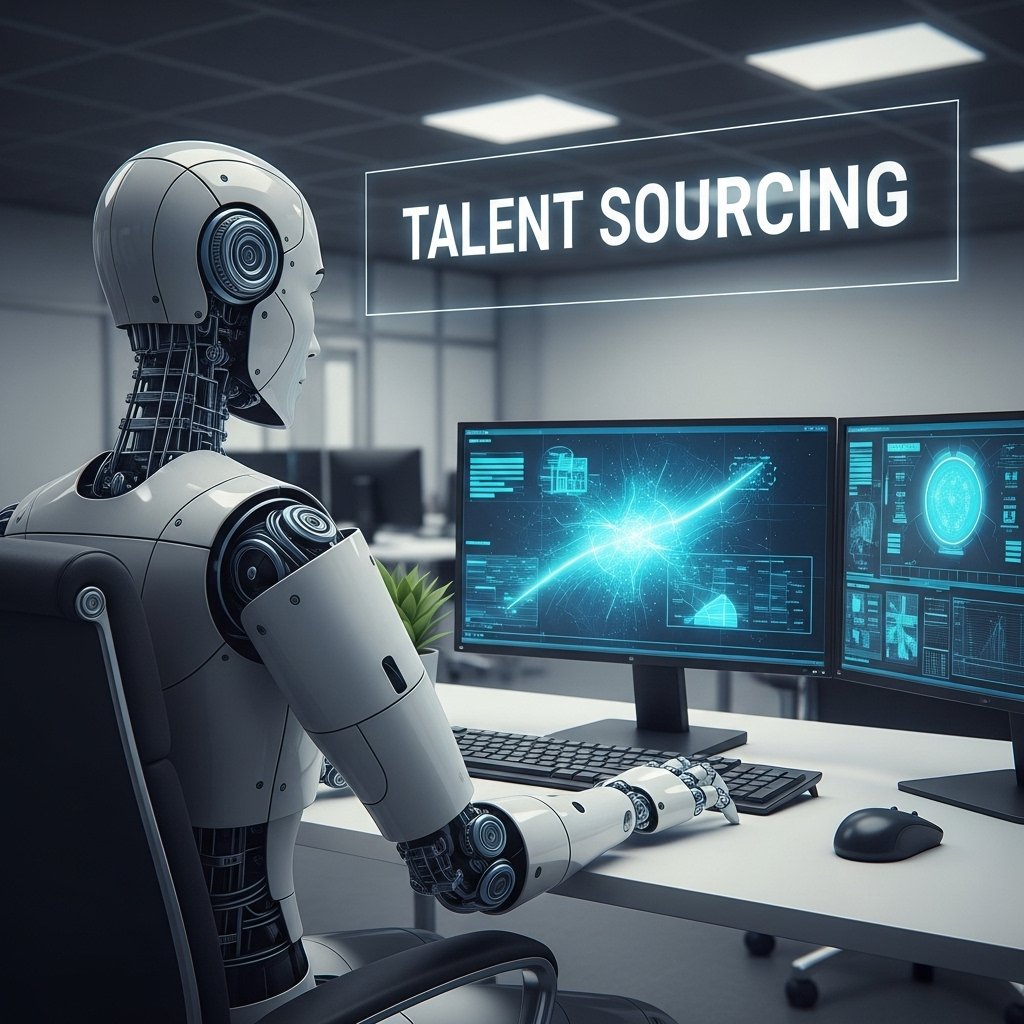
    The AI Revolution in Talent Sourcing: A Guide for Recruiters and Candidates

    The world of talent acquisition is undergoing a fundamental shift, moving from a reactive, administrative process to a proactive, data-driven strategy. For decades, the talent lifecycle was a manual, time-consuming journey of sifting through resumes and coordinating logistics. Today, AI is no longer a simple tool for automation; it has become a strategic partner that is redefining how companies find and engage with talent.

    This transformation is reshaping the entire recruitment ecosystem, from the technology companies use to the skills recruiters need and the way candidates must present themselves. The most successful organizations are those that are embracing this new reality, using AI to streamline repetitive tasks and free up human professionals to focus on the strategic, high-value work that only people can do. This guide explores this evolution and provides a playbook for both recruiters and candidates to thrive in the age of AI.

    1. The New Paradigm of Talent Sourcing: From Manual to Predictive

    Historically, talent sourcing was a reactive process where recruiters waited for applications to arrive and then manually reviewed them. AI is enabling a profound shift to a proactive, predictive strategy. AI-powered systems can now actively source and identify passive candidates who may not even be looking for a new role. These platforms use sophisticated Natural Language Processing (NLP) to understand the context and nuances of a candidate’s skills and experience, moving beyond rigid keyword matching.

    At its core, AI-driven sourcing is an engine for automation and efficiency. It streamlines key tasks, allowing recruiters to focus on the strategic elements of their job.

    • Intelligent Resume Screening: AI tools can analyze and rank thousands of resumes in minutes, filtering candidates based on job requirements with greater speed and efficiency than a human could. This drastically reduces the time-to-hire.
    • Generative AI for Content: AI is used to create compelling and inclusive job descriptions and to write personalized candidate outreach messages, which can lead to higher response rates.
    • Conversational AI: AI-powered chatbots and virtual assistants provide 24/7 engagement by handling initial candidate interactions, answering frequently asked questions, conducting pre-screening assessments, and automatically scheduling interviews.

    2. The Recruiter’s New Skillset: From Administrator to Strategist

    As AI automates the transactional tasks of the job, the role of the recruiter is being redefined. Instead of being a process executor, the modern recruiter is becoming a strategic talent consultant who advises on market dynamics and long-term workforce planning. This requires a new blend of human-centric and technical skills.

    The Hybrid Future of Search: For decades, Boolean search has been a foundational skill for recruiters. However, AI-powered sourcing is changing the game by using NLP to understand a recruiter’s intent from conversational prompts like “Find software engineers with experience in Python and machine learning who have worked in fintech”. This is not the end of Boolean search, but a new, hybrid approach. Recruiters can use Boolean for initial broad filtering and then use AI for deeper, context-driven insights, creating a powerful blend of both approaches.

    Essential Human-Centric Skills: The most valuable skills for recruiters in the age of AI are those that cannot be replicated by a machine.

    • Relationship Building and Empathy: AI cannot build authentic rapport with a candidate. The time freed up by automation allows recruiters to focus on building meaningful connections and understanding a candidate’s career goals and motivations.
    • Critical Thinking and Strategic Analysis: While AI delivers a wealth of data, a human is needed to interpret it, ask the right questions, and make nuanced, strategic decisions.
    • Negotiation and Communication: The ability to “sell” a job and an employer brand, and to help a candidate navigate a complex career decision, remains a uniquely human skill.

    New Technical Competencies: Recruiters don’t need to be data scientists, but they do need a new level of AI literacy. This includes understanding how their AI tools work, how to interpret the analytics they provide, and how to use them responsibly and ethically.

    3. The Candidate’s Playbook for the AI Era

    With AI tools being used by both employers and job seekers, there is a “technology arms race” taking place. Candidates are increasingly using AI to polish their resumes, while companies are using more sophisticated AI to filter the resulting flood of applications. Here is how a candidate can stand out and get noticed.

    • Optimize Your Resume for the Robots: The first step is to make your resume “machine-readable”. This means using simple, consistent formatting without columns, tables, or complex graphics. The single most important factor is the strategic use of keywords, which should be integrated naturally from the job description. A crucial piece of advice is to aim for a keyword match rate of 60-85% to avoid being flagged by the AI as a copy of the job description.
    • Focus on Skills, Not Pedigree: Modern companies are increasingly hiring based on demonstrable skills and experience rather than a candidate’s alma mater or previous job title. A candidate can give themselves a clear advantage by including a dedicated skills section on their resume and LinkedIn profile, making it easy for an AI screener to match their abilities to a specific role.
    • Be Authentic to Stand Out: With the rise of AI-generated content, human recruiters and hiring managers still value authenticity and thoughtful responses. A candidate should use AI as a tool for polishing and refining their content, not for generating it from scratch. Ultimately, a unique voice and personal touch are what make a candidate stand out in a sea of generic, AI-generated applications.

    4. How Technology is Changing the Hiring Ecosystem

    The integration of AI is fundamentally reshaping the core technological infrastructure of talent acquisition, including Applicant Tracking Systems (ATS) and Candidate Relationship Management (CRM) tools. The most significant trend in the market is the move toward integrated, all-in-one platforms, which combine ATS, CRM, sourcing, and outreach into a single system. This consolidation simplifies the entire workflow, provides a centralized view of the talent pipeline, and can lead to a significant reduction in time-to-hire and tech costs.

    The choice of a platform is a critical strategic decision. A company’s investment in AI recruitment reflects the market’s robust growth, with a projected value of over USD 56 billion by 2030. Platforms like Workable, Zappyhire, and Paradox offer a range of solutions, from comprehensive enterprise suites to tools focused on high-volume or niche hiring.

    5. The Ethical Frontier: A Mandate for Responsible AI

    While AI holds the promise of reducing unconscious bias in hiring, the reality is far more complex. The most significant ethical challenge is algorithmic bias, which stems from the principle of “garbage in, garbage out”. If an AI model is trained on historical hiring data that contains societal biases, it can replicate and even amplify those inequities. A University of Washington study, for example, found that AI resume screeners favored candidates with White-associated names 85% of the time and male-associated names 52% of the time, even for roles traditionally dominated by women.

    To mitigate these risks, organizations must adopt a proactive, multi-faceted strategy.

    • Mandatory Human Oversight: AI’s output should never be treated as the final word. A human must remain in the loop to monitor, interpret, and intervene when the results seem “off”.
    • Transparency and Vendor Due Diligence: Companies must push for transparency from their AI vendors, asking critical questions about how the algorithm makes decisions and what data was used to train it.
    • Regular Bias Audits: To proactively identify and address potential discrimination, organizations should conduct regular audits of their AI tools to look for disparate impacts across protected characteristics.
    • Legal and Compliance: Involving legal and compliance teams early in the procurement process is crucial, as the liability for discriminatory outcomes still falls on the organization, even if the technology is outsourced.

    The commitment to responsible AI is not just a compliance requirement; it can also become a powerful competitive differentiator that enhances an employer’s brand and attracts top talent who value fairness and diversity.

    Conclusion

    The future of talent sourcing is not a zero-sum game between humans and machines. Instead, it is a powerful, symbiotic relationship where AI handles the data and automation, freeing humans to focus on the strategic, relational, and empathetic aspects of hiring. The most successful organizations will master this high-tech, high-touch blend, using AI as a tool to augment human intelligence, drive a more efficient and equitable hiring process, and ultimately, rediscover the core of what recruitment has always been about: building genuine connections and finding the right people for the job.

  • The Definitive Guide to Strategic Workforce Planning in the Age of AI

    The Definitive Guide to Strategic Workforce Planning in the Age of AI

    The global business landscape is in a state of unprecedented flux. The rapid adoption of artificial intelligence is no longer a slow evolution but a seismic shift, reshaping industries and demanding a fundamental rethinking of how organizations manage their most critical asset: their people. In this new reality, traditional, reactive approaches to talent management are no longer a viable option; they are a significant liability.

    The evidence is clear: businesses that do not link their workforce strategy with the same rigor they apply to financial planning risk falling behind in agility, costs, and talent. In this guide, we’ll break down how to institutionalize workforce planning as a core business discipline and build an agile, future-proof organization.

    The New Calculus of Work: Augmentation Over Automation

    The impact of AI on the workforce is not a gradual, linear change but a rapid, accelerating, and systemic transformation. Data from 2024 indicates a significant increase in AI adoption: 75% of surveyed workers were using AI, with nearly half (46%) beginning to do so within the past six months.

    However, the proliferation of AI is also a source of significant disruption. Research from McKinsey suggests that by 2030, AI could automate up to 30% of work hours in the U.S. economy, especially in routine data and knowledge tasks. At the same time, this is creating an urgent need for human teams to focus on higher-value activities like strategy, innovation, and ethical oversight. This is a critical distinction that reframes the conversation around AI’s value from one of simple cost-cutting to one of geometric productivity growth.

    AI’s most profound impact is a fundamental shift from pure automation to human-AI augmentation. For example, AI-powered coding assistants have boosted developer efficiency by 10% to 20% at JPMorgan Chase, and the company plans to expand AI use to over 1,000 cases by 2026. The company has also seen AI contribute to over $1.5 billion in fraud prevention savings. This demonstrates that AI’s primary value proposition lies in its ability to enable employees to be more creative, strategic, and productive.

    The Strategic Pivot: From Headcount to Capabilities

    The advent of AI marks a pivotal moment for a clear distinction in HR: workforce management vs. workforce planning.

    • Workforce Management (WFM) is an operational function focused on the day-to-day administration of human capital, such as managing people data, tracking open roles, and aligning workforce costs. AI has become essential for streamlining these processes, automating tedious administrative tasks like resume screening and interview scheduling.
    • Workforce Planning (WP) is a proactive, strategic discipline that looks ahead to future talent needs. The process ensures the correct number of people with the right skills are employed at the right time to deliver on both short- and long-term business objectives.

    By offloading the “how” of workforce management, AI is forcing HR professionals to elevate their role and focus on the strategic “why” and “what” of workforce planning. A key part of this strategic shift is the transition to a skills-based organization (SBO) model. An SBO is a workforce framework that prioritizes individual skills and capabilities over rigid job roles, seeing employees as a collection of valuable skills that can be strategically deployed across the organization.

    This model helps organizations adapt quickly to changing market demands by aligning tasks with the specific skills of their people. It’s a move away from static, departmental teams toward dynamic, project-based assignments where teams are formed based on the specific skills required for a task, ensuring the right talent is deployed at the right time.

    The Toolkit for the Future-Ready Enterprise

    A core function of strategic workforce planning is to evaluate the future state of skills and experiences that will be needed to meet business objectives. This is achieved through a skills gap analysis, a strategic process that measures the difference between a company’s current capabilities and the skills and competencies needed to meet its long-term goals.

    In an AI-augmented environment, this process is more sophisticated and data-driven than ever before. AI-powered analytics now make it possible to catalog employee skills at scale, run precise gap analyses, and benchmark against competitors. These systems can process massive amounts of data from resumes, social media, and internal performance metrics to provide a comprehensive, up-to-date skills inventory in minutes, not weeks. This rapid analysis enables organizations to maintain a dynamic skills map of their entire workforce.

    The insights gained from this analysis empower organizations to make better, more informed talent decisions. For example, a company can identify existing generalist software developers with strong potential for upskilling and then build a plan to train them in a specific new technology like cryptography. This is more cost-effective than purely buying talent from a competitive external market.

    The Critical Partnership: Talent Acquisition as a Force Multiplier

    A strategic talent acquisition function is inextricably linked to workforce planning. While workforce planning identifies future needs, talent acquisition is the exclusive function responsible for executing the “buy” strategy—acquiring external talent.

    AI is transforming this function from a reactive process to a proactive strategy. By automating manual, repetitive tasks like resume screening, interview scheduling, and data analysis, AI frees up talent acquisition professionals to focus on more strategic, human-centric activities like building relationships with high-potential candidates.

    For instance, the global beauty company L’Oréal Group receives 1.5 million job applications each year. To manage this volume while ensuring a high-quality candidate experience, the company uses conversational AI tools to automate up to 95% of the hiring process for deskless teams, freeing recruiters to focus on strategic tasks. This proactive approach reduces hiring costs, decreases time-to-hire, and ensures the organization can secure a competitive advantage.

    Mitigating Risk: The Ethical Imperative

    The use of AI in HR, particularly in sensitive areas like hiring and talent management, introduces significant ethical and legal challenges. The U.S. Equal Employment Opportunity Commission (EEOC) has made the use of AI in employment decisions a top strategic enforcement priority, signaling a new era of regulatory scrutiny.

    The primary ethical risks include:

    • Algorithmic Bias: If past hiring data reflects historical biases—for example, favoring male candidates for certain roles—the AI will not only perpetuate but also amplify those same biases. This can lead to discriminatory hiring outcomes, a risk that resulted in Amazon scrapping an AI recruiting tool in 2018.
    • The Black Box Problem: Many AI systems operate as a “black box,” making decisions without providing a clear explanation of how they reached their conclusions. This lack of transparency erodes employee trust and makes it difficult to justify decisions to candidates or regulators.
    • Data Privacy: AI relies on massive volumes of data, and in HR, this includes sensitive personal information about employees and candidates. Mishandling this data can lead to breaches and legal liabilities.

    Given these risks, ethical AI governance is not a “nice-to-have” but a core risk management strategy. A comprehensive AI governance framework provides a structured approach to managing AI risk, ensuring ethical use, regulatory compliance, and accountability. The framework should be built on four core principles: fairness, transparency, accountability, and privacy.

    The Journey Begins Now: Your Action Plan

    The unprecedented pace of technological change is not a problem to be solved but a reality to be embraced. The most successful companies will be those that view AI as a catalyst for a fundamental transformation of their workforce strategy.

    The future of work is not a binary choice between human workers and automation. It is a new paradigm of human-AI augmentation where a proactive, skills-based approach creates a potent source of competitive advantage.

    To start this journey and build an agile, future-proof organization, senior leaders must take action now. Begin by conducting a comprehensive skills inventory to understand the current capabilities of your workforce. From there, define clear future scenarios and secure senior leadership buy-in to formalize workforce planning as a core business discipline. This strategic pivot ensures that talent is not just managed but proactively deployed, developed, and governed to meet the demands of an ever-evolving market.